Boldogságkeresés
Csongor és TündeBoldogságkeresés, or the search for happiness, is the work’s governing pursuit and its central paradox: longing gives Csongor a direction, but the journey does not guarantee that its desired end can be reached. Across the two speeches represented here, the search changes from an appeal for guidance toward Tündérhon into a meditation on unattainable desire, deceptive hope, and the possibility that a life’s route may close where it began.
The Call Toward Tündérhon
Csongor’s question about whether this is all for which a person lives turns the pursuit of happiness into a challenge to mere existence. The answer is not supplied as an abstract doctrine. Instead, the speech gives the question an emotional setting: a dark, empty, boundless breast, whose solitude seems terrifying. Happiness is thus defined first by what is missing—a sustaining connection and a purpose beyond isolation.
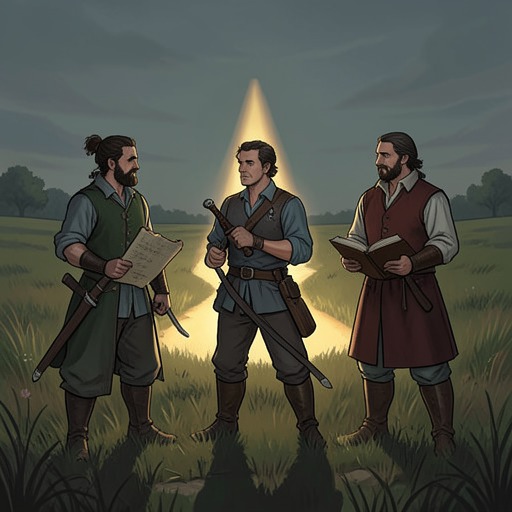
The appeal that follows makes love both the desired good and the means of seeking it. Csongor asks love to light a star on his way and to guide him toward Tündérhon. The image gives the quest a clear orientation: a distant destination is made imaginable by a light that can lead the traveler. Yet the guidance is an appeal, not a guarantee. Csongor exits after making it, and the journey proceeds under the sign of hope rather than certainty.
Desire and the Uncertain Road
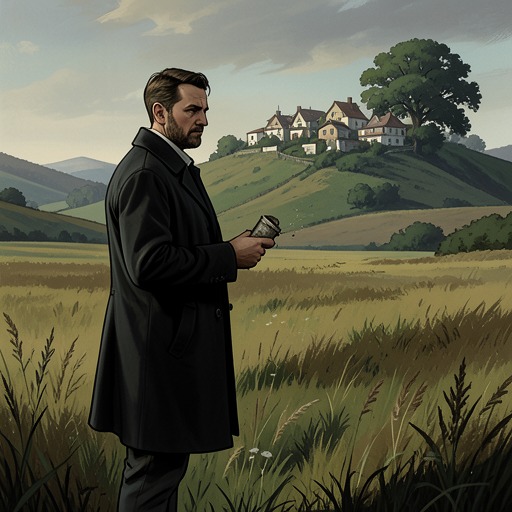
Later, the search is reconsidered from the far side of a long journey. Csongor declares human desire and its fairy-like, deceptive goal unattainable, then asks why the thirst remains unquenchable and why mysterious dreams and false prophecies accompany it. The repeated emphasis on unreachability turns the search into a problem rather than a straightforward route to happiness: desire persists even when its object cannot be securely possessed.
The journey’s duration sharpens that problem. Csongor recalls the long road endured under hope as a guide and asks what purpose it can have if its end lies where it began, in the uncertain middle of things. The image reverses the promise implied by a directed quest. A guide and a destination ordinarily distinguish forward movement from return; here, the traveler fears that the route may produce no final arrival at all. The question remains open in the passage, but its terms expose the cost of trusting a goal whose reality is uncertain.
Withdrawal from the World’s Measures
The later reflection turns away from the world’s apparent standards of success. Csongor describes escaping the world’s false gaze, while wealth and power are brought down from their elevated positions and reduced to burnt-out embers. The contrast strips prestige of its claim to offer lasting happiness: what looks elevated from within worldly judgment can end as ash.
This rejection does not establish a new, fully defined reward. Rather, it clears away the assumption that material wealth and authority can settle the search. The passage’s emphasis is on release from the world’s deceptive appearance, not on a concrete replacement for its prizes. Happiness therefore remains difficult to name even as familiar measures lose their authority.
Love, Hope, and the Slow Death of the Heart
The final images hold failed love and frustrated hope together: the young imagination dreams amid a love that has passed and a hope that has failed. Their pairing makes disappointment more than a single lost expectation. Love belongs to the past, while hope has also been thwarted; the seeker faces both what is no longer present and what did not come to pass.
Yet the passage does not describe this condition as a sudden catastrophe. It says that the heart’s death is slow and does not torment. That measured ending complicates the earlier appeal to love as a star: the light that first promises direction is set against a later world of exhausted hope, where the heart’s decline is gradual rather than dramatic. The search for happiness consequently remains both necessary and precarious. Its power lies in sustaining the road, while its danger is that desire may outlast its object and leave the seeker with uncertainty instead of arrival.